

What Happens When You Sell Your Dance Studio? Inside Ensemble Performing Arts’ Partnership Model
GET STARTED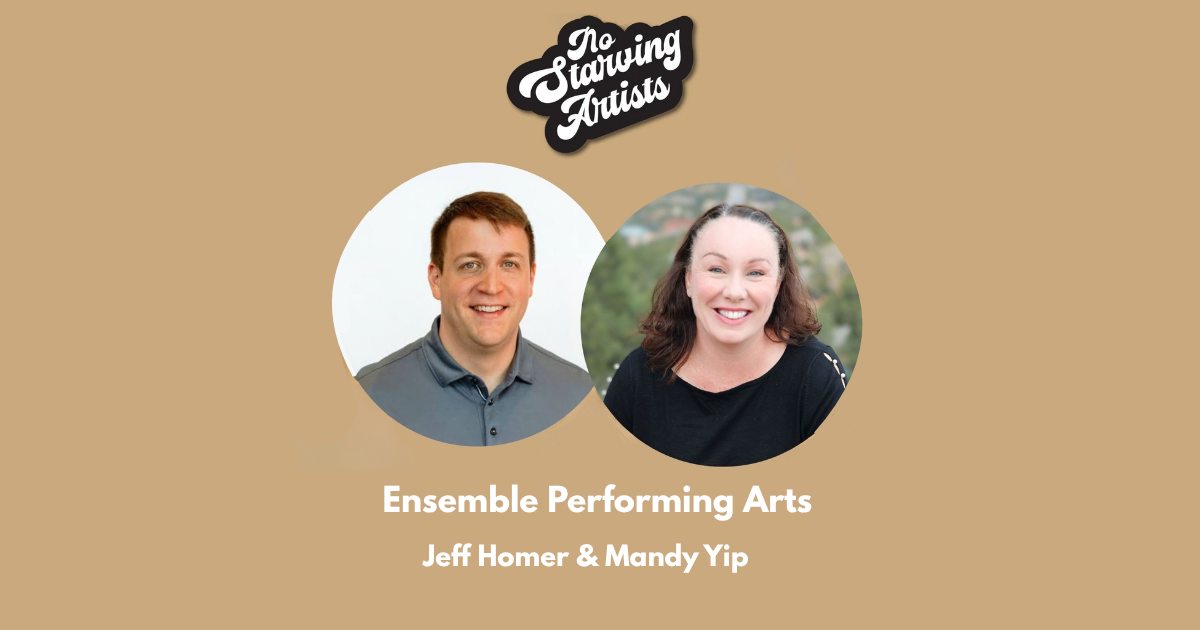
Your studio is more than a school — it’s decades of early mornings, late nights, recital seasons, and countless hours spent helping students discover something they love. So when you start thinking about selling your studio, the questions come fast:
- Will my studio’s culture change?
- Is this another example of private equity?
- Will someone else make decisions about how we teach?
- Will the people and families I’ve built this community around still matter?
Those questions are at the heart of a recent episode of No Starving Artists, where Jeff Homer and Mandy Yip sat down with Jason Pickett to talk about Ensemble Performing Arts’ unique business partnership model, and what that means for studio owners, teachers, students, and the communities they’ve spent years building.
It’s a conversation Jason has been building toward since he started the show. He launched No Starving Artists on the conviction that the arts are worth taking seriously as a career, and that the starving-artist story serves no one in the room — not teachers, not owners, and not students.
Selling a Dance Studio: A Personal Decision
Selling a business you’ve poured your life into is an incredibly personal decision, and Mandy Yip knows that firsthand. Before becoming the leader of Studio Solutions and Events at Ensemble Performing Arts, Mandy founded Acrobatic Arts, a leading professional curriculum and teacher training program for AcroDance. For Mandy, when it came time to sell her business, finding an organization that would genuinely care about the people she had built her company around was essential.
“This is my entire life I’ve poured into Acrobatic Arts, and it’s both the staff and the customers who are like family to me. The idea that I was going to put it into the hands of anyone who wasn’t going to care for that immensely just wasn’t an option. It was never going to be about the money for me. It never has been,” Mandy says.
And it isn’t just about the money for studio owners or for Ensemble. It’s about the people and strengthening the artistic communities that they built while creating more opportunities for teachers and students to grow. “The way that I built this business was sitting across from owners one at a time and making commitments to them in how I would treat the communities they had built,” Jeff Homer, Founder and CEO of Ensemble Performing Arts, explains. “And that’s still how we build the business today.”

Partnership vs. Private Equity
If you’ve heard about Ensemble and wondered whether we’re simply another private equity company buying up independent studios, the answer is no.
“Ensemble is a partnership,” Jeff explains. “It’s not a private equity firm or a venture capital firm. The folks that you see on the website that are identified as partners — what that means is they actually own the business. And so that means that the folks, like Mandy, that are partners in the business get a say in how and where we evolve.”
“There’s this fear that the ‘umbrella companies,’ whether they be in the private equity space or venture capital space, can limit opportunities for dancers. Do you think that fear is a real fear that people should have?” Jason asks Jeff and Mandy.
“I was certainly one of those concerned people,” Mandy admits. “But whether this is a good thing or a bad thing for artists comes down to who’s doing it and why they’re doing it.”
If you’re looking to sell your dance studio, you’re probably not interested in having some group or person come in, maximize their short-term returns, and move on to the next opportunity. You want a business partner that cares about the long-term quality of your studio experience and works to understand what makes your performing arts business unique. Ensemble’s model is built around the goal of preserving what makes the studio special while giving the people running it the support they need to succeed.
The Open Ecosystem of Ensemble Schools: Keeping the Heart of the Studio Intact
What Changes After a Partnership — and What Doesn’t
Every school Ensemble partners with is unique, and we work to keep it that way. The most common question we get is what changes after a partnership. One thing changes a great deal — who handles the back office. Three things stay right where they are: your vendors, your teaching, and your building.
At Ensemble, school leaders choose their own vendors. When Jason asked whether cross-selling happens inside the company Mandy was direct: Ensemble-owned vendors “have to compete in the open market the same as everyone else.” No school is required to buy from a sister business.
Your teaching stays your expertise.
That principle runs deeper than vendors: expertise stays where it already lives, and Ensemble builds underneath it rather than on top of it.
“Acrobatic Arts has benefited in the same way from becoming part of Ensemble, in terms of having back-office support and infrastructure to support the great front-end student experience and teacher experience that it’s delivering,” Jeff adds.
With our support on back-end operations, teachers and studio leaders can focus on the things they know best: teaching, mentoring, creating, and building relationships with their students.
As Jeff puts it, “I wouldn’t tell any teachers how to teach, because that’s not my area of expertise, but [I] would be in the office working hard to make sure they could just show up and do what they love to do.“
One thing does get stronger. Safety standards, background screening, and training requirements don’t stay where they were — partner schools adopt Ensemble’s safety standards, background check screening, and training requirements for professional conduct. It’s the one area where we don’t defer to local preference.
Your building stays your building.
Ownership can stay put in a more literal sense, too. Ensemble doesn’t acquire real estate when we partner with a new school, and the studio location doesn’t change. When Jason asks if there is a real estate component to our process, Jeff explains, “Ensemble does not acquire any real estate… In many cases, our sellers are our landlords.”
Owners can stay connected to the business while stepping back from day-to-day responsibilities, and they keep the building.
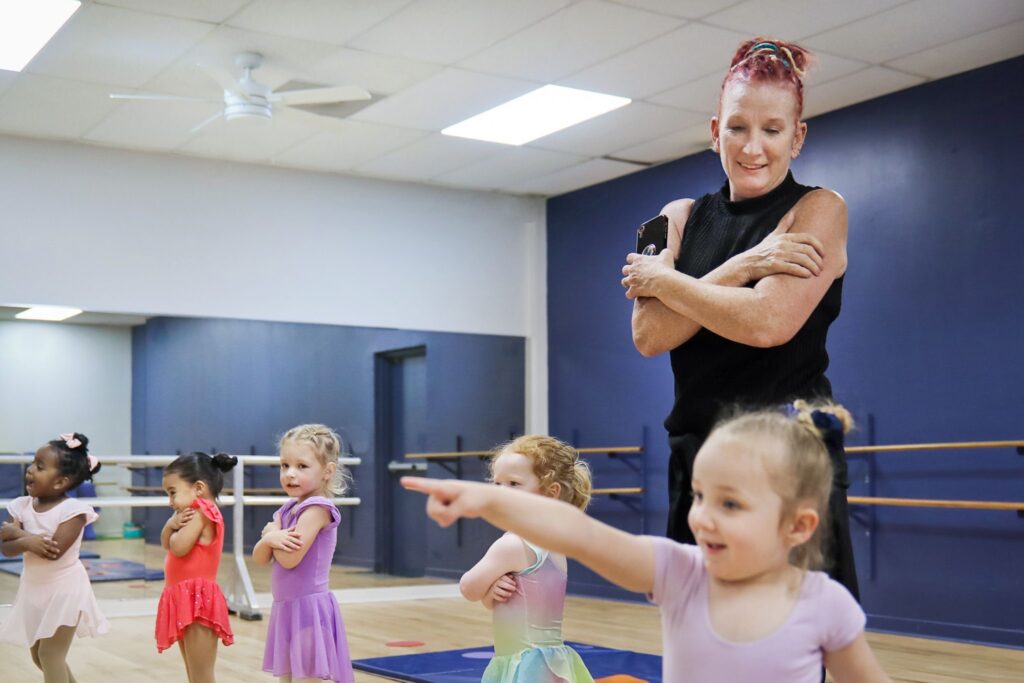
Providing Artists with Stability and Benefits
For years, the performing arts have been associated with the idea of the “starving artist,” the assumption that pursuing something you love necessarily means accepting financial instability. Mandy believes that assumption needs to change, and she sees a better way forward.
“It’s a world where a dancer can spend every day in dance, earn a great wage, have real benefits, and hopefully never have to answer the question I’ve been asked a million times: ‘Are you still doing that cute dance thing? What’s your backup plan?’” Mandy says.
Ensemble Performing Arts gives studio owners, teachers, and administrators the support they need to thrive including benefits, professional development, and back-office resources that let the people in the building spend more time doing what they love: teaching and dancing. For an owner, that support is often what makes it possible to offer a real career, with real benefits, to the staff they spent years training.

Conclusion
Ultimately, the conversation on No Starving Artists isn’t really about business transactions; it’s about people.
It’s about the owner who has spent years building a studio and wants to know that their community will be cared for. It’s about a teacher who wants to make dance a career instead of a side job. It’s also about creating a future for performing arts businesses where financial sustainability and artistic passion don’t have to exist on opposite sides of the equation.
“For so long dance has run on the myth of the ‘starving artist,’” Mandy says. “The idea that if you love it, you accept the struggle, but that doesn’t have to be the case.”
Jeff reassures studio owners, too: “It’s fair to be skeptical looking at somebody like me, but look at the folks who have chosen me over time.” He points out businesses like Acrobatic Arts that have continued to be successful after the transition to Ensemble. Mandy adds, “Our track record is going to speak for itself, and we have a responsibility to make sure we do the right thing at every step of this journey.”
“We often see studio owners who consider Ensemble, and end up selling to a right-hand or someone within the studio, and we think that’s a fantastic outcome,” Jeff says. “But if it’s not likely someone in your business is able to take care of it for you, I think we’re the perfect buyer.”
If you’re starting to think about what comes next for your studio, the conversation costs nothing. You can speak with us about your next steps by clicking here.
Listen to the full Episode 77 of No Starving Artists to hear Jeff Homer and Mandy Yip discuss Ensemble’s approach to dance, studio ownership, sustainable careers in the performing arts, and what it really means to build a performing arts community for the long term.
Author: Marisa E. Cardin
Marisa E. Cardin is the Assistant Manager of Neighborhood Music in Aurora, Colorado. She graduated with a Bachelor of Arts in Creative Writing from Metropolitan State University of Denver, Colorado in 2019. She is published in various magazines and chapbooks, including The Flagler Review and Perfume River Poetry. Most recently, she completed and published her sci-fi trilogy, Jax Cassaway and The Shadow Runners, in 2025. When she isn’t writing, she can be found jamming on her alto saxophone or cuddling her four cats. She currently lives in Aurora, Colorado.